
What to expect during All-on-4 surgery, step by step
By Kai Quinn · Updated 2026-06-29
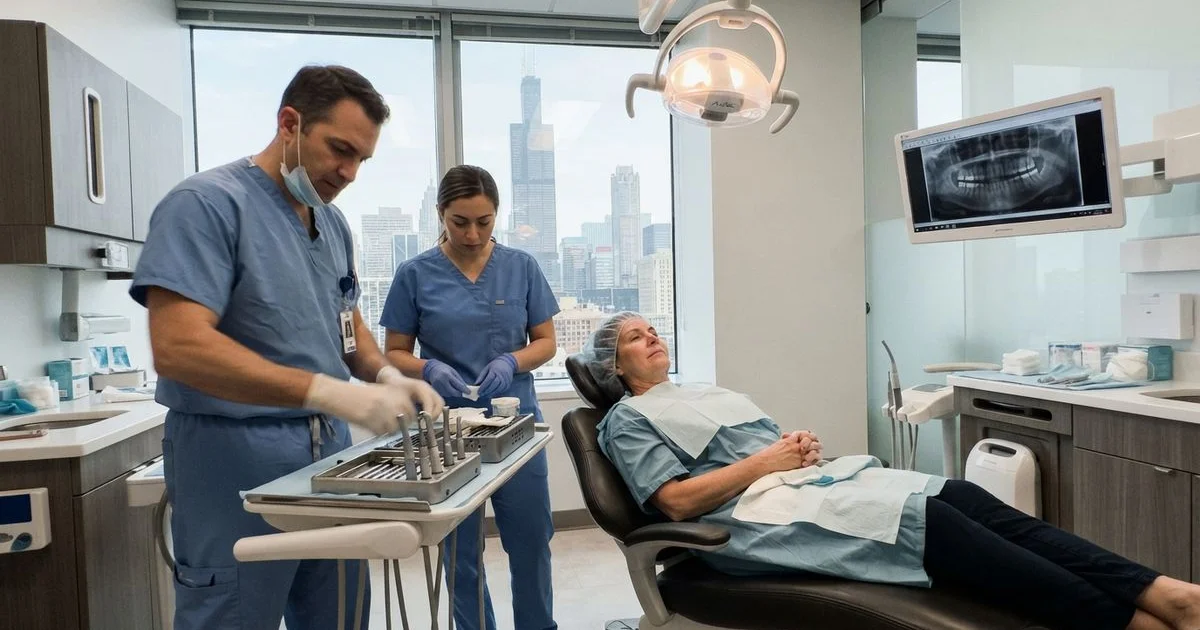
All-on-4 replaces a full row of missing or failing teeth with a fixed bridge held in place by four implants, done in a single surgical visit. It’s a bigger day than a routine implant, and knowing the sequence ahead of time makes it far less intimidating. Here’s what the appointment and the weeks after generally look like for All-on-4 and All-on-6 patients in Chicago.
Before surgery day
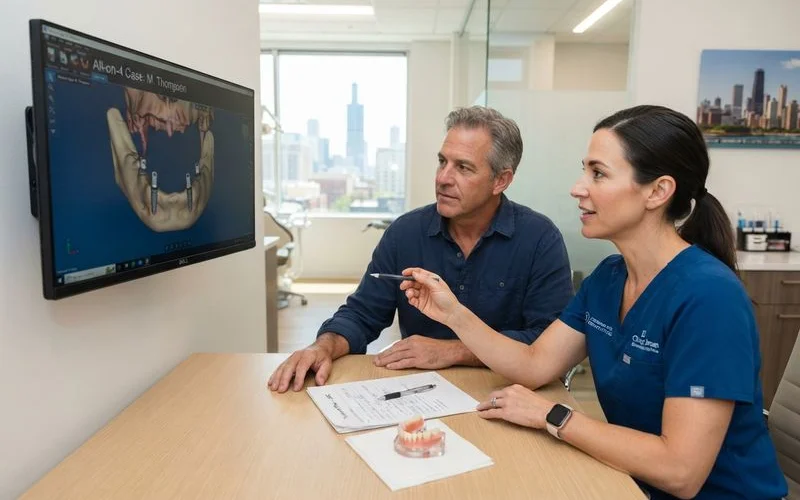
Your provider will have already taken a CT scan to map bone volume, nerve position, and sinus location, then planned exactly where each of the four implants will go. Most practices review this plan with you in a separate consultation so surgery day itself is just execution, not decision-making. You’ll get instructions on eating, medication, and arranging a ride home if you’re using sedation beyond local anesthesia.
The surgery itself
Once you’re sedated or numbed, the remaining teeth in that arch are removed if they haven’t been already, and the jawbone is prepared. The surgeon places four implants at calculated angles, often tilting the back two to anchor into denser bone and avoid the sinus or nerve canal. A temporary, fixed bridge is attached to the implants before you leave, so you walk out with a full set of teeth rather than a gap.
| Step | What happens | Typical time |
|---|---|---|
| Extractions (if needed) | Remaining teeth in the arch removed | 30-60 min |
| Implant placement | Four implants set at planned angles | 1-2 hours |
| Temporary bridge fitting | Fixed provisional attached same day | 30-45 min |
| Healing period | Bone fuses to implants | 4-6 months |
| Final bridge | Permanent prosthesis placed | Single visit once healed |
The first two weeks
Expect swelling that builds for the first 48 to 72 hours before it starts to go down, plus bruising for some patients. A soft-food diet is standard for the first several weeks; the temporary bridge isn’t built to handle hard chewing yet. Most people take three to five days off work or normal routines, longer if the job is physically demanding. Follow-up visits in the first two weeks let the surgeon check healing and adjust the temporary bite if anything feels off.
Healing and the wait for the final bridge
The implants need time to fuse with the bone, a process called osseointegration, before they can safely support a permanent bridge. That’s usually 4 to 6 months, sometimes longer in the upper jaw where bone tends to be softer. During this stretch you’re living on the temporary bridge, which some patients find noticeably different in feel and bite strength compared to the final version. It’s worth asking your provider directly what their average timeline has looked like for patients in a similar situation to yours, rather than assuming every case runs the same.
What separates a smooth case from a rough one
The biggest variable isn’t the surgery itself, it’s the planning that happens before it. Providers who use 3D imaging to map implant position, rather than relying on a flat X-ray and guesswork, tend to place implants at angles that hold up better long-term. Ask how many All-on-4 cases the surgeon has personally handled, whether they do the surgical and restorative work in-house or split it across two offices, and what their protocol is if an implant doesn’t integrate properly. A provider willing to answer these in detail, with real numbers, is usually a safer bet than one who glosses over specifics.
Life on the temporary bridge
Most patients describe the first month as an adjustment period rather than full normalcy. Chewing efficiency on the temporary bridge is noticeably lower than on natural teeth or the eventual permanent bridge, so sticking to soft foods, scrambled eggs, soup, pasta, fish, isn’t just a suggestion for week one, it protects the implants while they’re at their most vulnerable. Speech can feel slightly different for a few days too, since the shape of the temporary bridge differs from your natural bite. Both of these tend to resolve well before the permanent bridge goes in.
This is general information, not a substitute for a consultation with your own surgeon, who can walk through your specific bone structure, health history, and realistic timeline. Our methodology explains how we evaluate providers on training, transparency, and verified patient feedback, and the Chicago, IL Dental Implants Provider Guide can help you compare options once you know what to expect.
Common questions
- How long does All-on-4 surgery actually take?
- Plan on 3 to 5 hours in the chair for one arch, longer if both the upper and lower jaw are being done in the same visit. Extractions, implant placement, and fitting the temporary bridge all happen that same day.
- Will I leave with teeth the same day?
- Most practices send you home with a fixed temporary bridge attached to the new implants, so you're not without teeth. It's lighter and less refined than the final prosthesis, which comes later.
- How painful is recovery in the first week?
- Swelling and soreness typically peak around day two or three, then ease off. Most people manage it with prescribed medication and are back to light activity within a week, though full comfort with chewing takes longer.
- When do I get the permanent bridge?
- Usually 4 to 6 months after surgery, once the implants have fused to the jawbone. Your provider will take impressions or a digital scan once healing is confirmed.